
Culpeper Scheduled and Actual Release
A projected or scheduled release date is the agency’s current calculation based on the sentence data it holds. An actual release is the completed custody transaction. They may match, but they answer different questions. Court-awarded credit, credit earning class, discipline, sentence changes, detainers, mandatory minimums, and other legal events can change the calculation. Release staff must also verify identity, release authority, and holds from other jurisdictions before a Culpeper County jail departure.
Pretrial custody works differently. A person held while charges are pending has not received a sentence from which a good-time date can be calculated. A bond order, dismissal, or later sentence may create a basis for release, yet another case or hold may keep the person in custody. A court docket can explain the legal basis. It does not establish the exact moment staff completed release. For a sentenced person, use the system responsible for the sentence and preserve the exact live label.
Note: A weekend or holiday does not automatically move every Culpeper County projected release date to the prior Friday.
Find Culpeper Projected Release Dates
Classify the custody before searching. Culpeper County Jail and a Culpeper defendant housed under contract at Piedmont Regional Jail belong first to the local jail, court, and Sheriff records path. Coffeewood Correctional Center is a VADOC state prison. A federal sentence belongs in the Bureau of Prisons system, while an ICE transfer belongs in the immigration system. One search cannot cover them all.
- Identify the controlling authority. Use the case number, facility, sentence, and booking or DOC number. Ask whether the person is pretrial, locally sentenced, state-responsible, federal, or held for immigration action.
- For a Virginia state sentence, use VADOC. Search the Inmate and Supervisee Locator with the seven-digit DOC ID when possible. Otherwise, enter at least three first-name letters and the complete last name.
- Read the live field as labeled. Compare identifiers, location, custody or supervision status, and the release-related date. Do not claim every record has the same date label or a photo.
- For a local sentence, check both record types. Contact the Culpeper Sheriff jail contact for the custody calculation and actual event. Use the correct Culpeper court for the signed sentence and credit order.
- If the number is disputed, request the source records. Ask for the sentence computation, court-awarded credit, current classification, forfeitures or restorations, holds, and Culpeper’s written jail credit and revocation policy.
- Recheck after the date. Seek the release letter, jail transaction, VINE event, receiving agency, or state supervision record. A no-result alone is not proof of discharge.
The Culpeper County release-record path is useful when a local date has passed but the destination is unclear. It distinguishes community release from transfer to Piedmont, VADOC, ICE, or another jurisdiction.
Culpeper VADOC Date Computation
VADOC divides active sentences into Good Conduct Allowance, or GCA, and Earned Sentence Credit, or ESC, calculation families. For active GCA sentences totaling more than 12 months, VADOC calculates discretionary-parole eligibility, mandatory-parole release, and good-time release dates. GCA can range from zero to 30 days for each 30 days served, depending on classification. For active ESC sentences over 12 months, generally tied to felonies committed on or after January 1, 1995, earned credit reduces the term under the current statutory system.
The VADOC Time Computation page identifies major inputs: credit for confinement before VADOC received the person, sentence type and total, credit class changes, discipline, and other computation events. Concurrent sentences run at the same time. Consecutive sentences run one after another. A mandatory minimum is a portion the law requires to be served without ordinary reduction. These features are why a simple sentence-length calculator is not reliable.
Review the current VADOC time-computation source with the sentence documents.
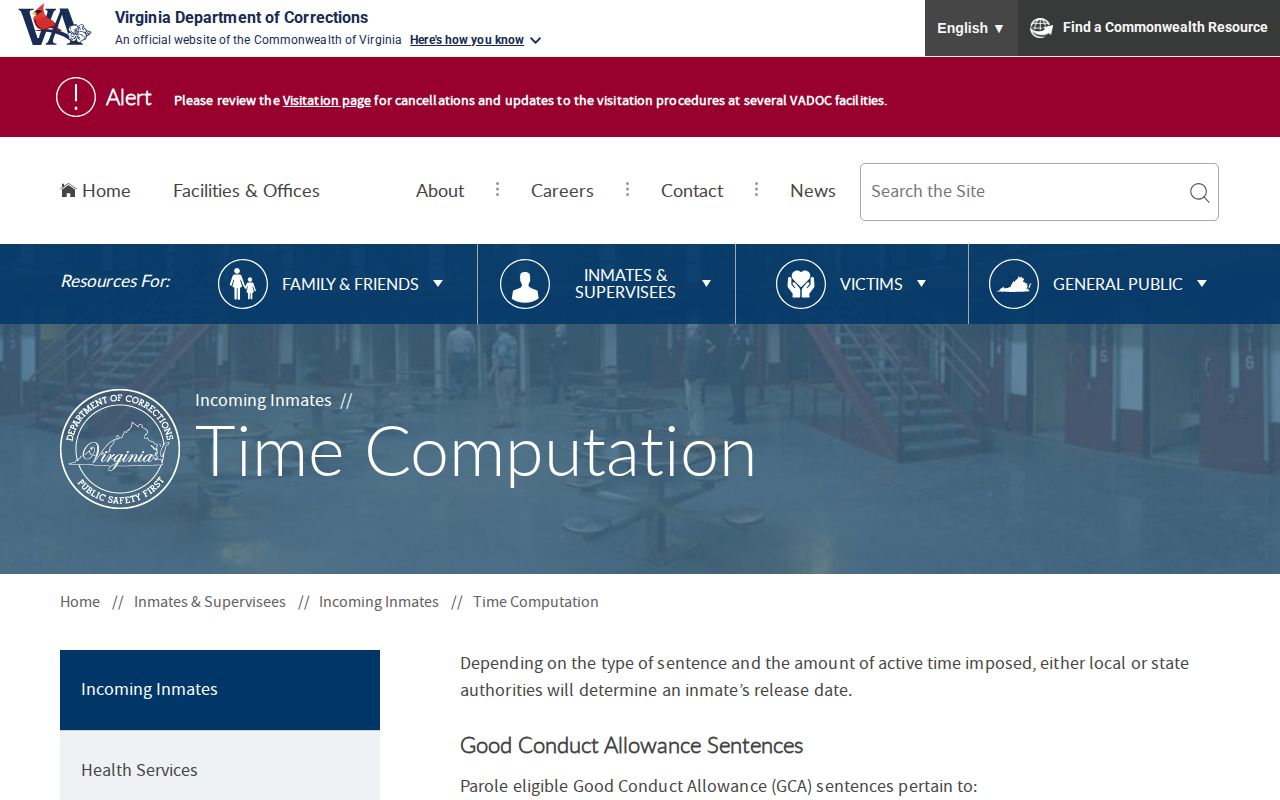
The image supports the method categories, while a person-specific date still depends on the agency’s own sentence record.
Culpeper Earned Release Credit Rates
Restricted offenses are described by VADOC as ESC-1. They can earn from zero to 4.5 credit days for each 30 days served. Other eligible offenses are in the expanded ESC-2 structure, with Level I at 15 days, Level II at 7.5 days, Level III at 3.5 days, and Level IV at zero per 30 days served. Classification is reviewed at least once each year and can change. The detailed restricted-offense list appears in §53.1-202.3; a shorthand label should not replace the statute.
The common “85 percent” statement comes from ESC-1 arithmetic. A maximum 4.5 credit days leaves 25.5 of each 30 days to serve, which is 85 percent. It is not universal. An eligible ESC-2 offense may earn more, while a lower class may earn less or no credit. Older parole-eligible sentences use other rules. Mandatory minimums, sentence structure, pretrial credit, and discipline can also control the result.
Open the current §53.1-202.3 source before applying a rate.
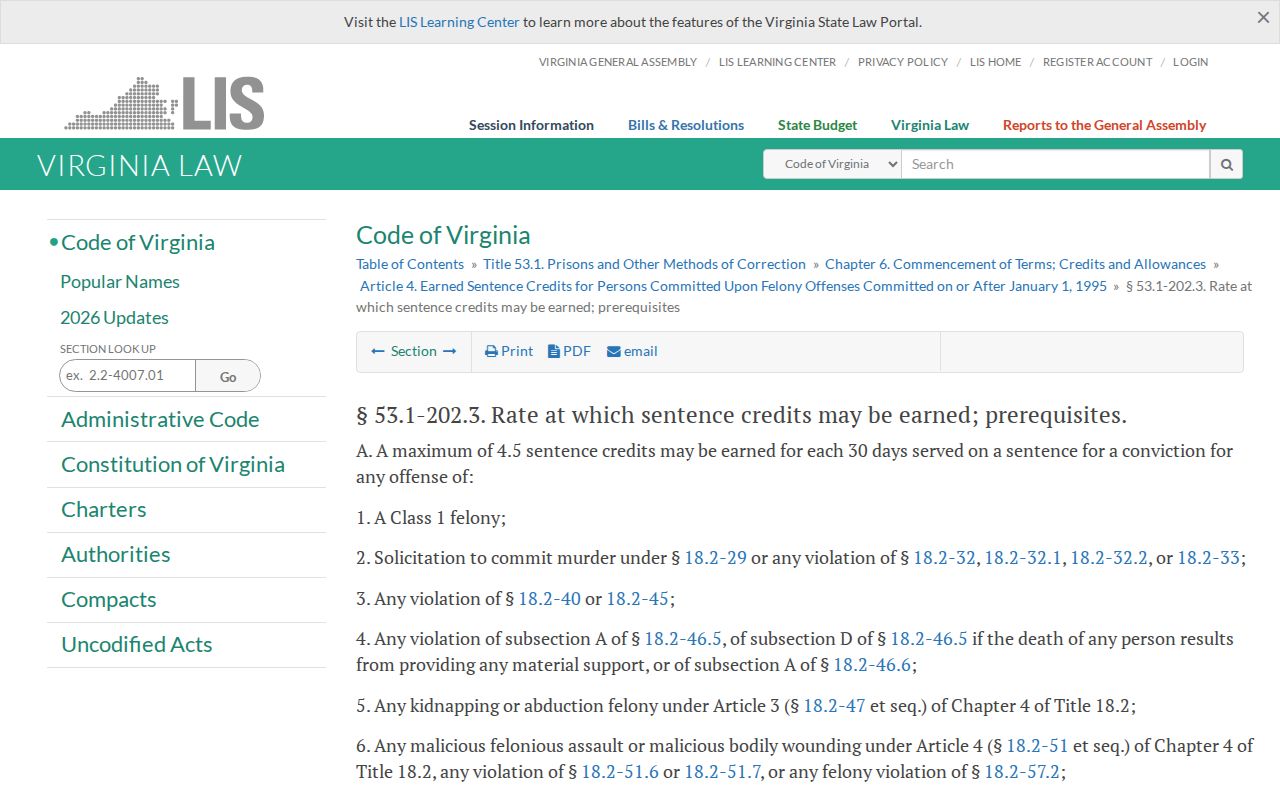
The captured law confirms the categories, but VADOC determines the person’s actual eligible offense and class.
Culpeper Earned Credit Definitions
The companion definition statute explains what an earned sentence credit deducts and how the agency’s conduct rules fit the calculation.
Read the current §53.1-202.2 definitions with the rate table.
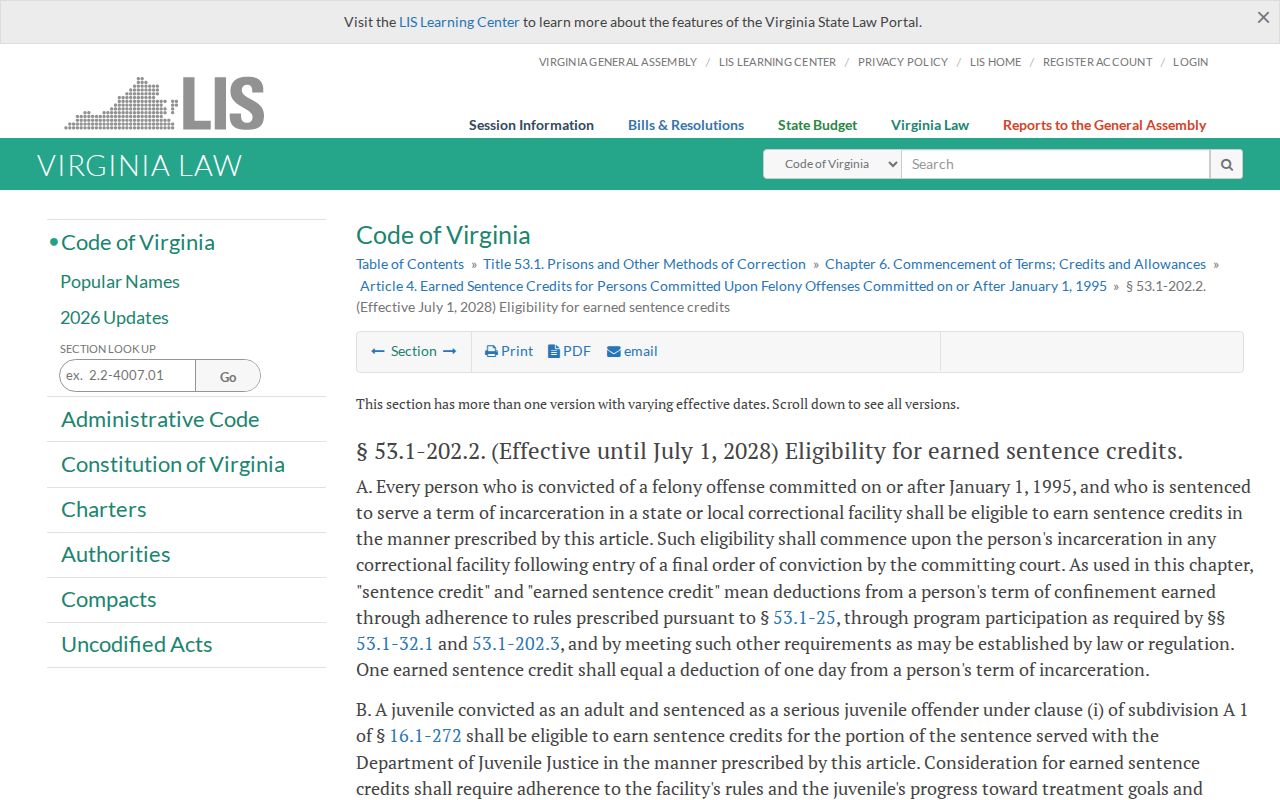
The definition image confirms the credit unit, while the person’s class and offense still control the rate earned.
Note: One earned sentence credit equals one day deducted, but eligibility and retention still depend on law, conduct, and agency criteria.
Culpeper Local Jail Release Credits
Current Virginia Code §53.1-116 gives a qualifying misdemeanor prisoner sentenced to 12 months or less one good-conduct credit day for each day served. Qualifying pre-conviction days can count. Rule violations and mandatory-minimum limits still apply. The statute also addresses possible extra credit for work, classes, or programs where available, subject to a written local policy. Post-1994 felony credit remains restricted by the ESC framework even when the person is housed in a jail.
This is Culpeper’s key computation quirk. The jail must maintain a written policy for credits and revocation, so that policy is more useful than a generic online calculator when a local date is disputed. Ask for the exact sentence entry, each credited day, the policy version used, any forfeiture or restoration, and the final calculation. For a court-credit dispute, obtain the signed order from Culpeper General District Court or Culpeper Circuit Court, as the case requires.
Read the current §53.1-116 text rather than relying on an older summary.
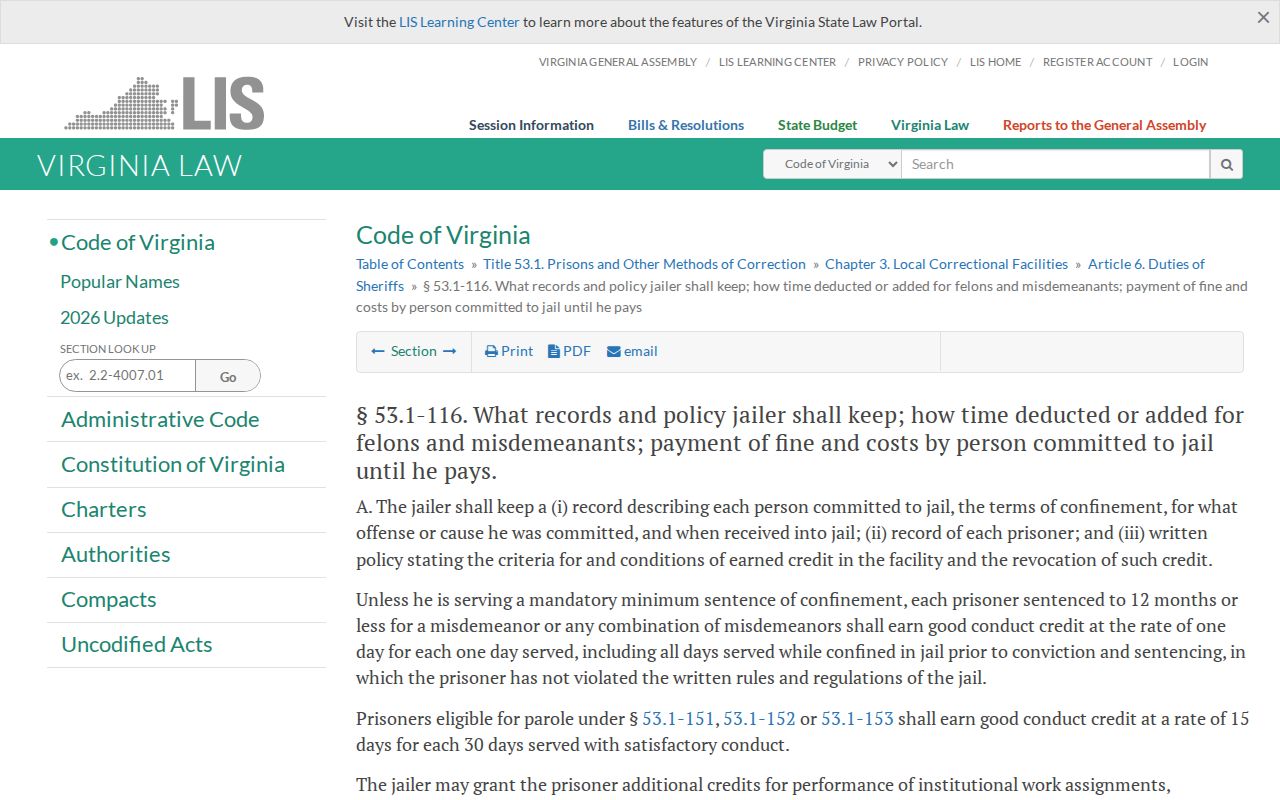
The statute defines the legal credit rule. The Sheriff’s own record shows how that rule was applied to the named sentence.
Culpeper Release Date Variables
A release date moves only when an underlying legal or administrative input changes. Ask which input changed and seek the record that supports it. This keeps a revised date from being mistaken for an unexplained delay.
| Variable | Possible effect | Best record to check |
|---|---|---|
| Pretrial confinement credit | Can reduce qualifying time left to serve | Signed court order and agency computation |
| Concurrent or consecutive structure | Changes whether terms overlap or follow each other | Sentencing orders and computation sheet |
| Credit class or program earning | May raise or lower the credit rate | Current VADOC or jail classification record |
| Discipline, forfeiture, restoration | Can add time back or restore credits | Agency credit ledger and lawful decision |
| Mandatory minimum | Limits the portion credits may reduce | Statute, conviction, and sentencing order |
| New court order or sentence change | Can revise the controlling term | Signed order, not just a docket shorthand |
| Detainer or outside hold | May turn release from one authority into transfer | Hold, warrant, and receiving-agency record |
A detainer is a request or notice from another authority concerning custody. It can prevent community release even when the original sentence date arrives. A parole grant also is not an exit date. The Virginia Parole Board makes the decision, and VADOC later implements release under §53.1-136. Keep the decision date and physical release date separate.
Note: “Time served” is a sentencing result, not an exit timestamp; jail staff must still process the order and check holds.
Culpeper Date Lookup by Custody
The access channel determines what the date means. Culpeper Sheriff records can establish a local release or transfer time. Piedmont Regional Jail can confirm physical placement and departure information when disclosed, but the committing authority may still be Culpeper, VADOC, or USMS. VADOC is primary for state-prison sentences and community supervision. Court records establish the legal basis. VINELink relays provider events and may lag.
| Custody type | First date source | Confirmation |
|---|---|---|
| Culpeper pretrial detainee | Court order or bond event, not a sentence projection | Sheriff actual release or transfer record |
| Culpeper local sentence | Jail computation plus signed court sentence | §53.1-122 release-time entry and destination |
| Virginia state sentence | VADOC locator and computation | Release letter, later status, District 26, or VADOC record |
| Federal sentence | BOP Inmate Locator | Past date with no BOP location, plus any supervised-release or other-custody check |
| ICE custody | ICE detainee locator | ICE or records response; recent released entries are time-limited |
USMS pretrial custody has no public release roster like BOP. If Piedmont housed the person for USMS, use the federal court order, the holding jail, USMS records, and any later BOP record. A federal locator absence does not prove a Culpeper community release.
Confirm Culpeper Actual Release Date
After the projected date passes, look for the event that proves what happened. A VADOC result that changes from an institution to District 26 can support physical prison release into community supervision. A release letter is stronger. If a fully discharged person leaves the current locator, request an inactive-offender record. For a local sentence, ask the Sheriff for the exact date and time, release category, authority, and destination. The Sheriff’s official records form is the fallback when a phone check is not enough.
Virginia VINE can add a reported custody event. Registration and event coverage vary by provider, and a “release” notice may need a call to learn whether it meant community release or transfer. Instructions for a one-person alert appear on the Culpeper County VINELink check. Keep the provider, event wording, time, and confirmation details, then compare them with the jail or VADOC record.
- Projected date
- The agency’s current estimate based on sentence and credit data.
- Actual release
- The completed departure from the identified custody authority.
- Good-conduct allowance
- Credit framework used for qualifying older or parole-eligible sentence calculations.
- Earned sentence credit
- Days deducted under Virginia’s conduct, program, offense, and class rules.
- Detainer
- A notice or request from another authority that can lead to continued custody or transfer.
- Discharge
- The end of the identified custody or supervision authority, not merely a move between facilities.
Keep both dates when the person moves between systems. Departure from Culpeper local custody may be a transfer date. Departure from VADOC physical custody may occur later, followed by supervision. Only the record from each responsible agency can state its own event with precision.