
Culpeper County VINELink Coverage
VINELink is the public entry point for Virginia VINE local and regional jail information. For a Culpeper County jail case, the record may carry a provider-reported custody status or event from the participating local system. Events listed in Virginia’s official material can include release, transfer, death, escape and return. Some facilities may also supply work-release, name-change, parole, or advance-release events. Availability varies by provider. VINELink does not turn those possible event types into a promise that every Culpeper record will display each field.
The first task is to identify the custody layer. Someone arrested on a local Culpeper charge belongs first in the Sheriff, regional-jail, court, and local VINE path. A person serving a state sentence belongs in the Virginia Department of Corrections system. Culpeper also contracts beds at Piedmont Regional Jail, so departure from the local jail building may mean a transfer to Farmville, not freedom in the community. VINELink relays the data supplied by the provider. It is not the jail’s commitment and release record.
The successful VINELink capture in the image manifest shows the official search and notification environment. Review the official VINELink service before entering a name or ID.
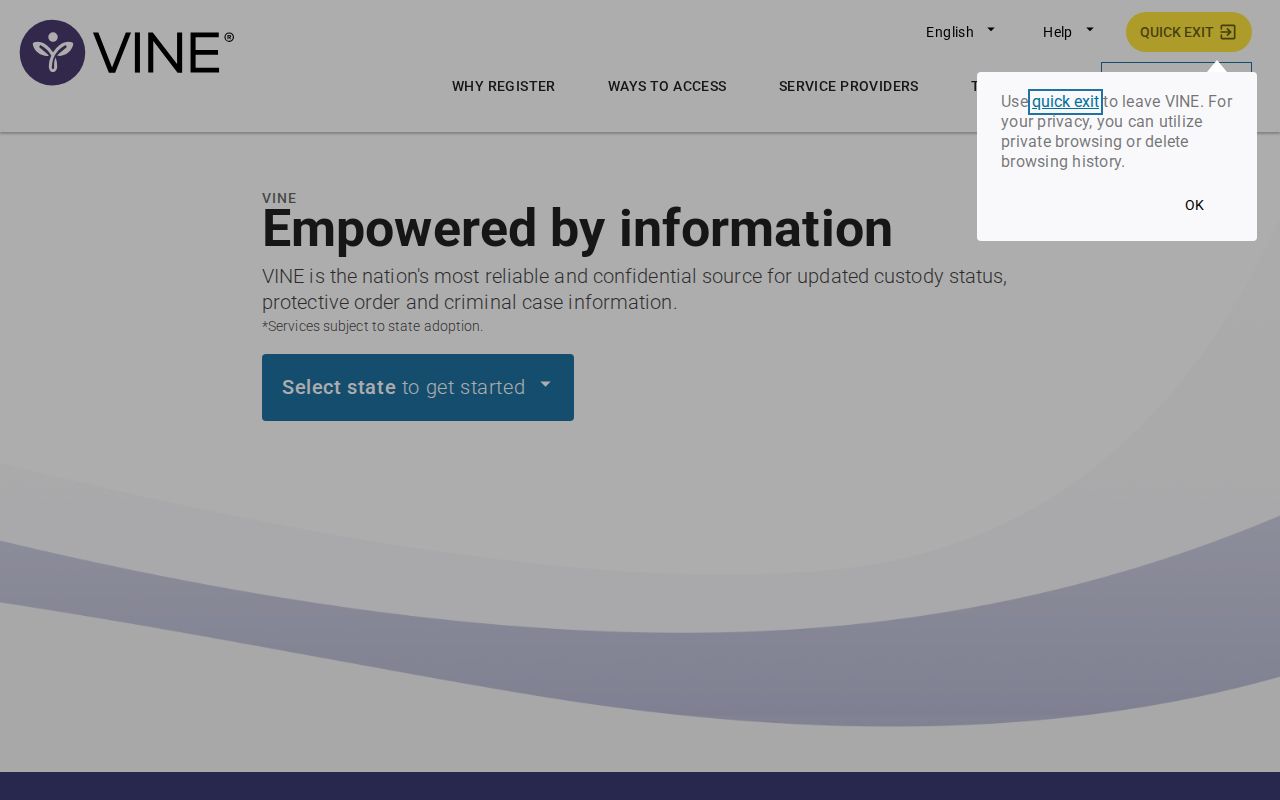
The screen is a route to a provider record, not proof that the person reached the community. The provider name and exact event wording control the next verification step.
Search Culpeper County on VINELink
Search one person at a time and use known identifiers. Names can be shared, shortened, or entered differently at booking. An ID is stronger when available. Before accepting a match, compare the name and any supplied age, date of birth, ID, facility, or provider detail. A close name match without a consistent identifier is not enough.
- Open VINELink and choose Virginia as the state.
- Select the offender search and enter the person’s name or available ID.
- Review possible matches and compare every identifier the provider displays.
- Open the matching custody record and note the provider, status or event, event time if shown, and callback contact.
- Save the retrieval date and exact wording. Contact the feeding agency if “release” does not make the destination clear.
A no-result has several possible causes. The person may be at a contract facility, newly booked and not yet posted, transferred to VADOC, fully discharged from the system, in federal or immigration custody, or entered under different identifying data. The full Culpeper County release-search sequence on the home page supplies the Sheriff, court, Piedmont, VADOC, and records-request fallbacks when VINE alone does not resolve the question.
Note: Record the search date because provider data changes and a later screen may show a new custody event.
Read Culpeper County VINE Results
A VINELink result should be read as a provider report. The interface can change, and not every record shows the same labels. Capture the terms that actually appear. Do not replace them with a broad claim such as “free” or “out” when the event may describe a transfer. Virginia’s minimum jail-release process includes a check for outside holds, so the end of Culpeper custody can lead directly to another authority.
| Result detail | What it can establish |
|---|---|
| Name or offender ID | Helps distinguish the intended person from a similar name. |
| Provider or facility | Identifies which jail or agency supplied the event. |
| Custody status or event | Reports the provider’s current label, such as custody change, release, or transfer. |
| Event date or time | Shows when the supplied event was posted or took effect, if the record displays it. |
| Callback contact | Points to the agency that can clarify destination and underlying custody facts. |
A court order answers a different question. The Culpeper General District Court or Circuit Court record may show bond, dismissal, sentence, or another legal basis for release. It usually does not prove the moment jail staff completed processing. Pair that legal record with the VINELink event and, where needed, the Sheriff’s exact release-time and destination record.
Register Culpeper County Release Alerts
Registration attaches a chosen delivery method to the matching record. Available methods may include phone, text, email, TTY, or an in-app notice. Choose more than one route when the interface permits it and the event matters to personal safety or release planning. Contact details must stay current. A disabled phone, full inbox, blocked caller, or changed email can prevent a notice from reaching its intended destination.
- Open the verified Culpeper County custody record and select its notification option.
- Choose each offered delivery method that can be checked reliably.
- Enter the phone number, email address, TTY detail, or app information requested.
- Complete the verification step. For automated phone alerts, create a private PIN.
- Enter that PIN during the notification call to confirm receipt and stop repeat calls.
- Update or replace the registration if the person moves into a different custody system.
A phone PIN confirms that the message was received. It does not certify the event’s legal meaning. Save the event wording, provider, time, and any confirmation number. Then call the provider when community release versus transfer matters. For urgent decisions, do not rely on one automated delivery channel.
Separate Culpeper Notification Layers
Virginia does not use one universal enrollment. Local and regional jail VINE follows events supplied from local custody. VADOC Victim Services is a separate, restricted state channel for eligible victims. Its enrollment is not automatic. The official Virginia VINE brochure says a victim registered with VADOC should also register separately while the person is housed in a local jail. This split matters in Culpeper because the Sheriff publishes no official release feed.
Virginia’s Sex Offender Registry is a third layer. It applies only to people who are legally required to register and concerns registry identity, location, and compliance information. Registry address or compliance alerts are not jail-release alerts. A registry result cannot establish the exact date someone left the Culpeper County Jail, and absence from the registry says nothing about most released people.
The Virginia statute displayed in the assigned image addresses local notification through statewide VINE. Read Virginia Code §53.1-133.02 for the distinctions among release, discharge, transfer, work release, escape, and name change.
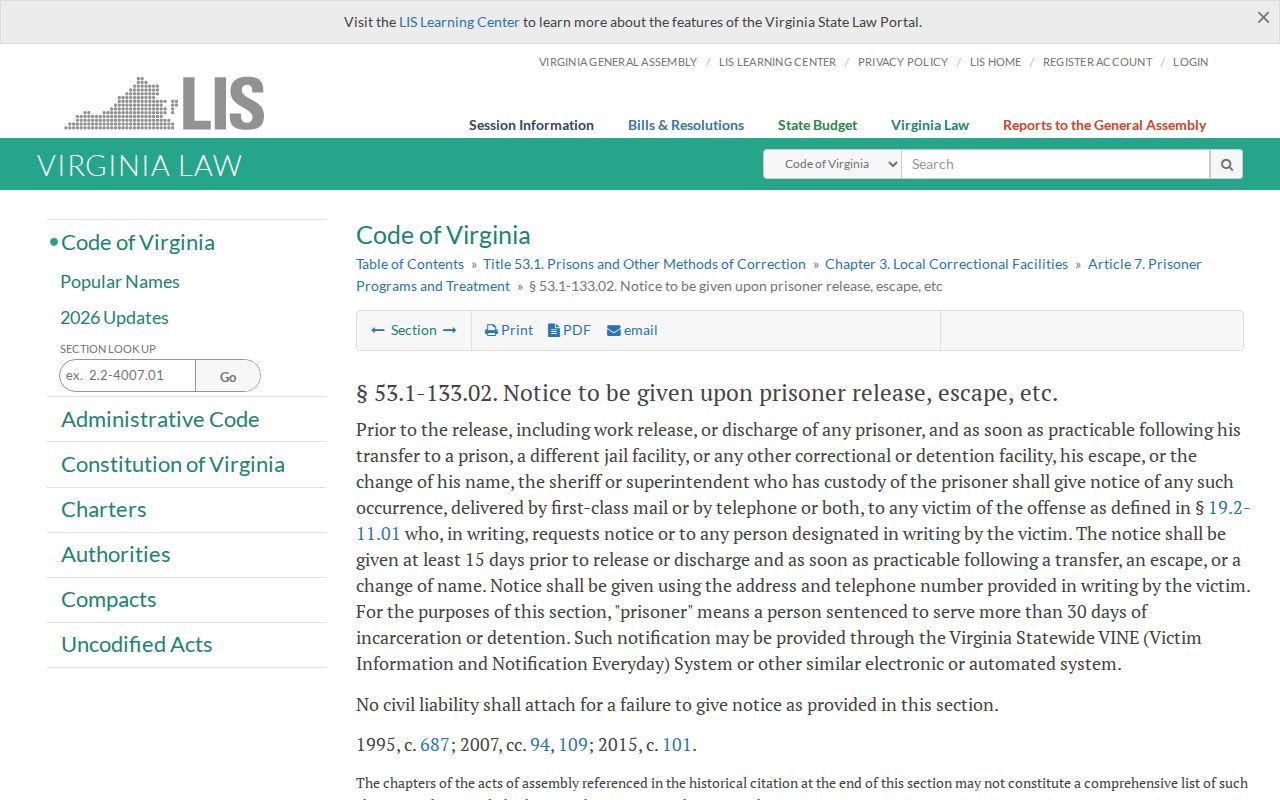
Those distinct event types explain why the label must be preserved and checked. Registration should follow the person when custody shifts from a local jail to VADOC.
Confirm Culpeper County Release Alerts
When VINELink sends a Culpeper County release alert, save it before the record changes. Note the person’s identifiers, the provider, event label, event time, and callback number. If the message says transfer, follow the receiving facility. If it says release but gives no destination, contact the Culpeper Sheriff’s jail contact and ask whether the custody transaction was community release or movement to another jail, VADOC, ICE, or another jurisdiction.
Culpeper’s contract-bed use makes Piedmont Regional Jail an important check. A state-responsible person should be checked in the VADOC Inmate and Supervisee Locator. That tool covers people under state custody or community supervision and says its data update daily, though the information may still be stale or inaccurate. A VADOC supervision result can support physical release from prison while showing that state control continues.
For the strongest local proof, request the Sheriff’s existing custody history and daily release entry. Virginia law requires a daily record that includes release time and custody category. That record can distinguish a bond or sentence-completion exit from a transfer. VINELink remains useful because it can provide timely notice, but the originating office owns the source record.
Keep each stage distinct when a person moves through more than one system. A local VINE event can show departure from Culpeper custody. A later VADOC locator result may show state custody or supervision. An ICE result can show that immigration custody followed the local event. These records do not conflict merely because their dates or labels differ. They may describe consecutive parts of the same custody path. Write down the local departure time, receiving agency, later status, and source for each fact. That short timeline is far more reliable than treating the first alert as the end of the matter.
Culpeper Release Alerts Have Limits
VINELink does not cover every federal custody event. A person held by the Bureau of Prisons belongs in the BOP locator. A US Marshals Service pretrial prisoner may be housed at Piedmont, yet the legal authority remains federal. The USMS does not offer a public release roster like BOP. Federal court records, the holding facility, the BOP system when applicable, and federal records channels answer that case.
Immigration custody also needs its own path. A local jail can complete its release authority and transfer a person under an ICE detainer. That event should be described as release from local custody into immigration custody, not community release. ICE’s locator covers current detainees and a limited recent-release period. Older events may require an ICE records request.
Finally, a missing VINELink result is not a finding. Data delay, a transfer, an identity mismatch, full discharge, or coverage in another system may explain it. Use VINE to search a specific record and receive events. Use the Sheriff or VADOC record to confirm the custody transaction, the correct court to identify the legal basis, and the receiving authority to show where the person went next.
Note: A release notice, court order, or locator result is strongest when another official source confirms the person’s destination.